What is a perc test and soil evaluation in Macon?
A soil evaluation tells you what the ground on a lot can do with wastewater: how fast it absorbs, how deep it goes before water or rock, and whether it can take a standard field at all. In Georgia a certified soil classifier produces it and the county health department reviews it. In Macon, where the ground changes across the Fall Line, it is the most important document in the whole project.
A good evaluation can save a purchase, move a house, or change the system from a standard field to something else. A bad one, or none, surfaces at permit time when changing course is expensive.
What the evaluator looks at on a Macon lot
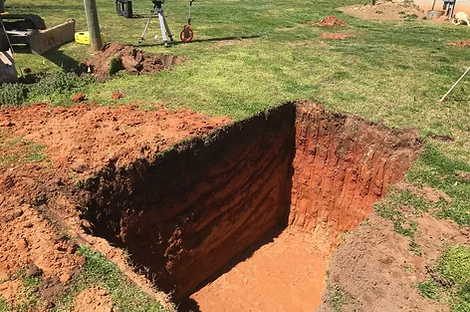
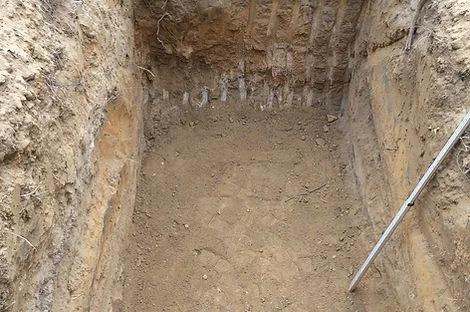
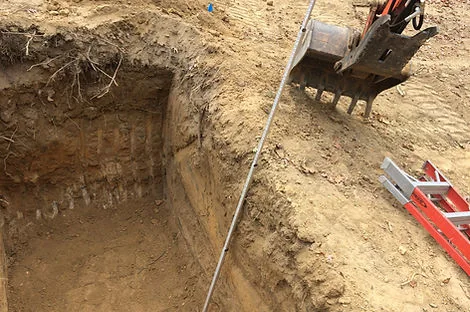
- Soil texture and structure at several depths, read from pits dug on the lot.
- Seasonal high water table, read from soil colors, because the water is not always there when the evaluator visits.
- Depth to bedrock or restrictive layers. Georgia's manual wants 2 feet of suitable soil under the trench, or 1 foot with Class I aerobic pretreatment.
- Slope. Over 25 percent is unsuitable without a special investigation.
- Fill and disturbed soil. The manual excludes fill without special approval.
The state manual also expects the evaluation to reflect the lot after grading. If earthwork is planned, say so.
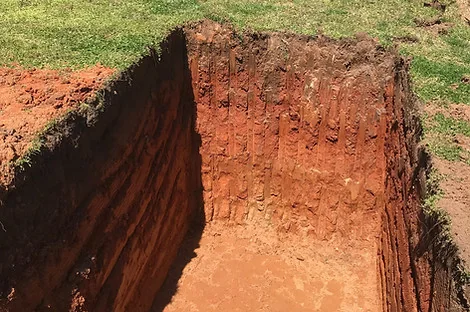
Why Macon results vary so much
North of the Fall Line the land is hilly over crystalline rock. Evaluators watch depth to rock and slope.
Alluvium along the Ocmulgee holds the water table within a few feet in flat, slowly draining ground, according to the state survey. Evaluators read groundwater here first.
Sand drains fast, with red or pink hardpan layers below. Evaluators map those layers.
Clayey subsoil within a few feet of the surface slows absorption. Evaluators size the field to it.
The Fall Line soil guide lays these out as a cross-section.
Check a lot before you buy it
Put the soil evaluation in your inspection period. Ask the health department what it has on file for the parcel, and ask whether sewer is available at Macon Water Authority, (478) 464-5600. A lot that looks perfect can fail, and a lot that looks unbuildable can pass with an alternative system.
From evaluation to permit
Request the evaluation
Contact the Macon-Bibb County Health Department at (478) 749-0106 and ask how they handle evaluations for your situation.
Evaluator visits
Pits are dug and the soil is read. Mark the lot and tell the evaluator about wells, slopes, and planned grading.
Design
We size the system to the result and the bedroom count.
Permit
The department reviews the design and issues the permit before anything is built.
How to prepare for the evaluator
- Mark the corners of the lot and where the house will sit.
- Tell the evaluator about wells, ponds, drainage ways, and anything buried.
- Clear access for a person with a shovel and, if needed, a machine.
- Call 811 before any digging so buried utilities are marked.
- Say how much grading is planned. Georgia's manual expects the evaluation to reflect the lot after grading.
Reading the result
A passing result still names a system type and a field size, and those decide the cost. A marginal result is where design choices matter: a pumped, raised, or aerobic system may bring a lot into range. A failing result is not always the end. Ask what changes the answer, such as a different house location, a smaller bedroom count, or an alternative design. See alternative systems before you walk away.